We’d all like to crack the code and recoup losses related to Wall Street’s nosedive. Unfortunately, there’s no panacea. There are, however, simple lessons in the history of two indicators, the Dow Jones Industrial Average (DJIA) and the Gross Domestic Product (GDP).
The GDP is the tangible output of American business – goods and services produced and purchased, raw materials processed, crops harvested, houses started and sold, and more. The GDP represents the meat and potatoes of the economy – real infrastructure, real human capital. The Dow and other market indices represent the combined value of shares in selected businesses based on their potential to provide a return on investment. Wall Street is part of a financial support system whose mission should be to boost the GDP through prudent investments in business enterprises, as it did for a large part of the 20th century. Accordingly, one would expect a meaningful correlation between the Dow and GDP, on average – and there was until 1982, as visibly displayed in Figures 1 and 2, covering data to October 2008.
Figure 1
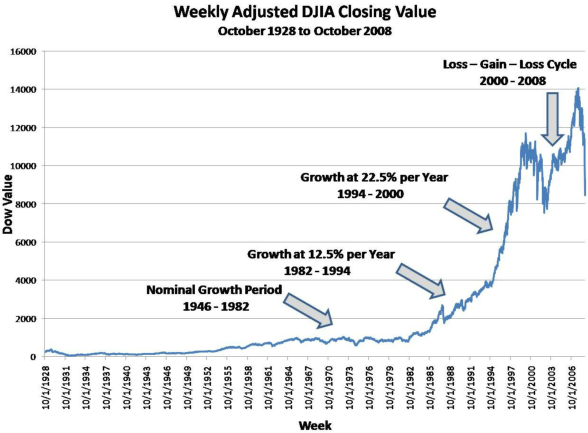
Figure 2
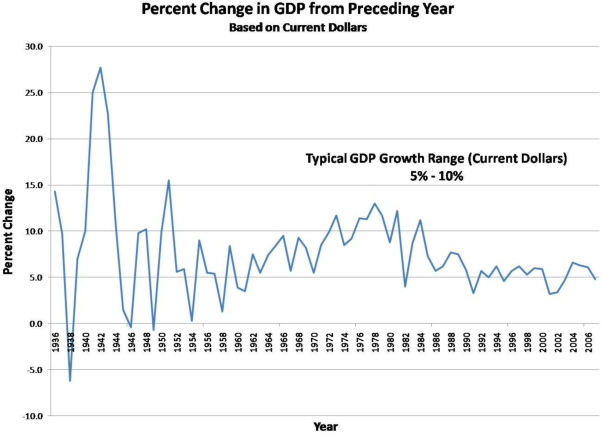
In current dollars, the GDP grew an average 6.9% per year from 1946 to 2007. Over the same period, the adjusted point value of the Dow climbed an average of 6.7% per year to its 14,093 peak in October 2007. At first glance, the Dow’s long-term rise seems on par with the GDP, but wait. Between 1946 and 1982, the Dow underperformed the GDP’s average annual growth rate, about 4.3% (Dow) to 7.8% (GDP) – a strong and steady correlation. Besides dividend payouts, the invest-in-America mindset provided over 4% annual growth to investors. However, in Roaring Twenties fashion, from 1982 to mid-1994, Wall Street went wild. The Dow soared at 12.5% per year, attracting average citizens and their money. From mid-1994 to January 2000, the Dow jumped an incredible 22.8% per year compared to the GDP’s modest 5.7%. The surge created an impression of wealth only, eventually attaining levels well beyond the capacity to pay off the overvalued accounts – meaning time for an adjustment. In 2000, a prolonged correction occurred through 2003, dropping the Dow about 4200 points, roughly 36%. Importantly, the GDP averaged a 4.3% growth per year during the selloff meaning the “real economy” (GDP) can grow even amid wild fluctuations and declines in Wall Street indices. Beginning in 2003, the DJIA should have made only historically modest gains, but we know what happened. Unchecked, frenzied financiers sought higher return on investment by exploiting the already fragile housing and mortgage industries, boosting market values again. From 2004 to 2007, the Dow rocketed at 13.4% per year. The GDP averaged 6% increase per year.
What does all this mean? Starting in 1982, the paper valuations of Wall Street quietly gained credence as the nation’s indicator of economic vitality, enticing average citizens, private groups, businesses, and even the federal government to invest heavily in stocks, mutual funds, and/or get-rich retirement vehicles. The government furthered the euphoria by enacting laws and policies favoring various investment schemes, helping to promote overvaluation and speculation. Indefensible increases in market value broadly occurred over many years, but the payout for stocks, mutual funds, IRAs, and other holdings was never there. The trillions of dollars seemingly lost in the recent meltdown were only paper earnings, but a minority of sly financiers and financial intermediaries did pocket hundreds of billions lost by the majority of average investors. Almost like clockwork, the retirement of the first baby boomers marked the recent market selloff and devaluation. The only way to pay the pending cash-in of retirement investment accounts was to adjust their value – or worse, undervalue them. Almost overnight, dreams of a comfortable retirement vaporized as risk became reality.
The primary lesson for individuals: if the stock market continuously outpaces the GDP, investors beware! Market devaluation is just around the corner and it’s time to cash out. As for Wall Street, it must re-earn our trust. Who, after all, wants to stake their financial future on fickle financiers and flighty investment prospects?
The main lesson for the nation: monitor and counter financial practices leading to extended or rapid overvaluation and speculation. A prolonged steep rise in the Dow with only a nominal rise in GDP means something’s amiss, foretelling a future rapid drop-off and more unfulfilled expectations. Speculators only harm the economy through short-term overvaluation, as they favor one sector of the economy at the expense of the rest. For example, recent speculation in oil caused the price of a barrel to more than double even though supply and demand remained relatively fixed. The oil companies swept up huge windfall profits while petroleum and transportation-related consumer prices rose steeply. The government barely batted an eye.
Now, our awakened government has bailout-mania, meaning added debt and tax burdens. Bailouts require thoughtful analysis and a significant potential for a return on the “people’s investment.” It’s time for the government to put a leash on itself and Wall Street to ensure sensible investment in America, for America. And we’ll know if Wall Street is aboard when slow and steady is its course, and Wall Street is aligned with real-growth prospects.
